


When an Indian citizen becomes seriously ill or suffers an accident while travelling, working, or living abroad, getting the right medical treatment becomes the immediate priority. But once the patient’s condition is stable, families may face another major challenge: how to safely bring the patient back to India for continued treatment or recovery.
This process is known as medical repatriation.
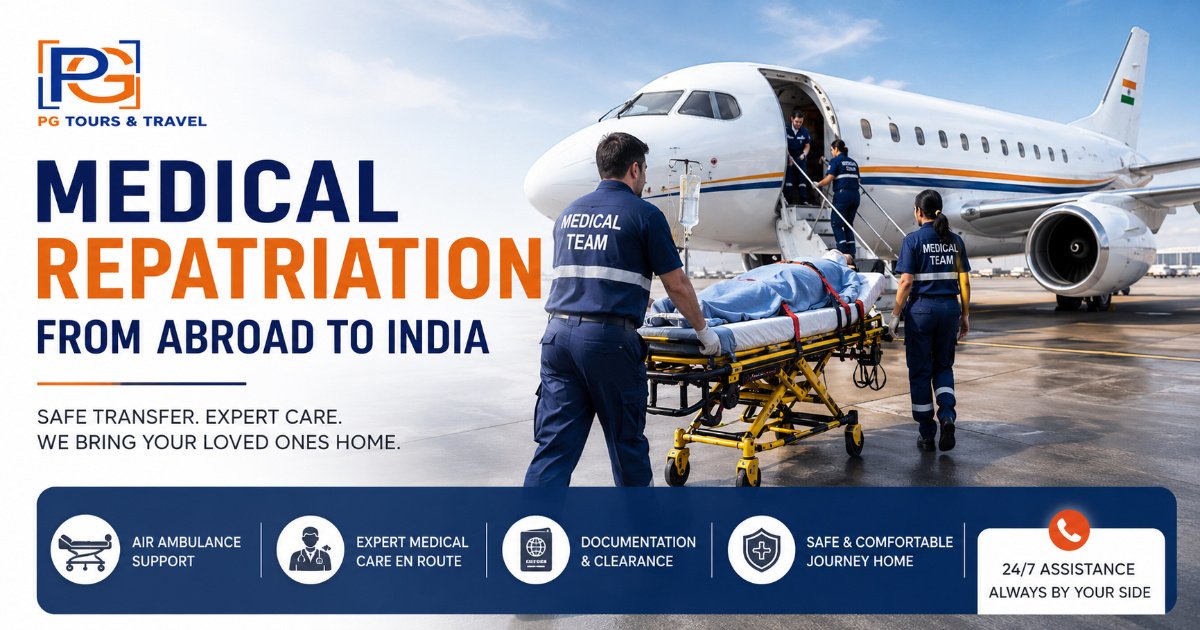
Medical repatriation is not simply booking an international flight. Depending on the patient’s condition, it can involve medical assessment, hospital coordination, medical clearance, airport assistance, ground ambulance services, medical escorts, or a dedicated air ambulance.
For families already dealing with a medical emergency in another country, understanding the process can make the situation easier to manage.
What Is Medical Repatriation?
Medical repatriation refers to the process of returning a sick or injured person to their home country for continued medical treatment, recovery, or family support.
For example, an Indian traveller may be hospitalised in Dubai following an accident. After the patient’s condition becomes stable, the family may decide to continue treatment at a hospital in India. Depending on the medical assessment, the patient could travel by a commercial flight with assistance, a medical escort, or an air ambulance.
A typical repatriation journey may involve:
Foreign Hospital → Ground Ambulance → Airport → Medical Flight → Indian Airport → Ground Ambulance → Receiving Hospital
The exact arrangement depends on the patient’s medical condition and transportation requirements.
Why Do Patients Need Medical Repatriation to India?
There are several reasons families may choose to bring a patient back to India.
India has a large network of hospitals and specialist medical centres, which may allow patients to continue treatment closer to their family. Some patients may already have doctors or hospitals in India familiar with their medical history.
Family support is another important consideration. When a patient remains hospitalised abroad for an extended period, relatives may face difficulties with accommodation, communication, travel and long-term caregiving.
Returning to India can allow family members to participate more easily in the patient’s ongoing care.
However, the decision should always be based on the patient’s medical condition and the advice of qualified medical professionals.
When Is Medical Repatriation Considered?
Medical repatriation may be considered after:
- A serious accident abroad
- Major surgery
- Sudden illness
- Long-term hospitalisation
- A medical emergency during travel
- A condition requiring specialised treatment
- A patient becoming medically stable after emergency treatment
Being stable enough to leave a hospital does not automatically mean the patient is fit to fly.
Doctors may evaluate the patient’s mobility, oxygen requirements, risk of deterioration, need for monitoring, medication requirements and ability to tolerate the journey.
Commercial Flight, Medical Escort or Air Ambulance?
One of the most important decisions is choosing the correct transportation method.
A medically fit patient may be able to travel on a normal commercial flight. In certain cases, additional assistance or a medical escort may be required.
Patients with more complex medical requirements may need an air ambulance with trained medical personnel and appropriate equipment.
| Transportation | Generally Considered For |
| Commercial flight | Stable patients who can travel normally |
| Commercial flight with assistance | Stable patients requiring additional support |
| Medical escort | Patients who can fly commercially but need professional assistance |
| Air ambulance | Patients requiring specialised medical supervision during transportation |
The choice should be based on medical suitability rather than convenience or price alone.
From Foreign Hospital to Indian Hospital: The Complete Journey
Medical repatriation involves several stages that need to work together.
1. Medical Assessment
The treating doctor first evaluates the patient’s condition and ability to travel.
Medical reports may include diagnosis, treatment history, current medication, mobility status and other relevant information.
This information helps determine the appropriate transportation method.
2. Transport Planning
Once the medical requirements are understood, the appropriate travel arrangement can be planned.
For some patients, commercial travel may be possible. Others may require a medical escort or air ambulance.
The distance between the hospital and airport must also be considered.
3. Overseas Hospital Transfer
The patient may require a ground ambulance from the hospital to the airport.
For bedridden or critically ill patients, ordinary transportation may not be appropriate. The ground ambulance should be selected according to the patient’s medical requirements.
4. International Medical Transportation
The patient then travels to India using the selected transportation method.
In an air ambulance, medical professionals can provide appropriate monitoring and support throughout the journey based on the patient’s needs.
5. Arrival in India
Arrangements should ideally be made before the aircraft arrives.
A ground ambulance may be required to transfer the patient from the Indian airport to the receiving hospital.
6. Hospital Handover
The final stage is the transfer of the patient to the receiving medical team.
Medical records and relevant information should be made available so that treatment can continue without unnecessary delays.
What Documents Are Required?
Documentation can vary depending on the patient’s situation, country of departure, airline and transportation method.
Families may commonly need:
- Passport and identification documents
- Medical reports
- Hospital discharge summary
- Medication details
- Doctor’s fitness-to-travel or medical clearance documentation
- Insurance documents, where applicable
- Receiving hospital details
- Emergency contact information
Families should confirm specific requirements before finalising transportation arrangements.
How Much Does Medical Repatriation to India Cost?
There is no single fixed price for medical repatriation.
The total cost can vary considerably depending on several factors, including:
- Departure country
- Flight distance
- Patient’s medical condition
- Type of aircraft
- Medical team required
- Medical equipment
- Oxygen requirements
- Ground ambulance services
- Airport-related arrangements
- Urgency of transportation
An international air ambulance can involve considerably more resources than a standard commercial flight, so families should request a case-specific quotation rather than relying on generic online prices.
What Happens If the Patient Needs Oxygen?
Oxygen requirements must be evaluated before travel.
A patient who requires oxygen should not simply be booked onto a flight without confirming the appropriate medical arrangements.
The patient’s treating doctors and medical transport team can determine the required level of support and whether the selected transportation method is suitable.
This is one reason why medical assessment should take place before finalising the journey.
Can a Bedridden Patient Be Brought Back to India?
In many cases, patients with significant mobility limitations can be transported, but the arrangements need to be planned carefully.
A bedridden patient may require assistance during:
- Hospital departure
- Transfer into the ambulance
- Airport movement
- Aircraft boarding
- Arrival procedures
- Transfer to the receiving hospital
The patient’s medical condition should determine the type of transportation and assistance required.
Medical Repatriation After an Accident Abroad
Accidents are one of the situations in which families may suddenly need international medical transportation.
For example, an Indian citizen travelling overseas may suffer a serious road accident and require hospitalisation. Once the patient is medically stable, the family may want treatment to continue in India.
The process may involve coordination between the foreign hospital, treating doctors, insurance provider, medical transport team and receiving hospital in India.
In such circumstances, quick but medically appropriate planning is essential.
Medical Repatriation for Elderly Parents Living Abroad
Another common situation involves elderly Indian parents or relatives living outside India.
Age alone does not determine whether someone requires an air ambulance. However, elderly patients may have additional mobility or medical requirements that need to be considered before long-distance travel.
Families should obtain medical advice and determine whether the patient can travel commercially or requires specialised medical transportation.
What About Travel Insurance?
Travel insurance policies may sometimes include medical evacuation or repatriation benefits, but coverage depends entirely on the policy’s terms and conditions.
Families should check:
- Whether medical repatriation is covered
- Whether prior approval is required
- Coverage limits
- Exclusions
- Required medical documentation
- Whether the insurer must coordinate the transportation
It is important not to assume that every medical transportation expense will automatically be covered.
How PG Tours & Travel Can Support Medical Travel Arrangements
Arranging medical travel from another country can involve several separate elements, including transportation planning, airport coordination, ground transfers and travel arrangements.
PG Tours & Travel can assist families with travel-support requirements related to medical transportation, helping coordinate the journey according to the patient’s circumstances and destination.
The medical decision regarding whether a patient is fit to travel should always remain with the treating doctors and qualified medical professionals.
For families, having the travel arrangements coordinated properly can reduce some of the logistical burden during an already stressful situation.
Common Mistakes Families Should Avoid
Families arranging medical repatriation should avoid making transportation decisions too quickly.
One common mistake is booking a regular flight without first confirming that the patient is medically fit to fly.
Another is failing to arrange the receiving hospital before the patient leaves the foreign country.
Families should also avoid overlooking the ground ambulance requirement. The medical journey does not end when the aircraft lands.
It is equally important to understand insurance conditions and keep medical documentation organised.
Medical Repatriation Checklist
Before arranging the patient’s return to India, families should consider:
- Speak with the treating doctor
- Confirm whether the patient is fit to travel
- Collect medical reports and hospital documents
- Determine the required level of medical assistance
- Choose the appropriate transportation
- Confirm the receiving hospital in India
- Arrange departure airport transfer
- Arrange an Indian airport ambulance
- Check insurance requirements
- Confirm travel documentation
- Keep emergency contacts available
Conclusion
Medical repatriation from abroad to India requires much more than arranging a flight ticket. It involves medical assessment, transportation planning, hospital coordination and appropriate ground and airport support.
Some stable patients may be able to travel commercially, while others may require a medical escort or dedicated air ambulance. The correct option depends on the patient’s medical condition and the advice of the treating medical team.
For families dealing with an emergency overseas, early coordination can make the process more organised. From the foreign hospital to the receiving hospital in India, every stage should be planned around the patient’s medical requirements.
If you are arranging the return of a sick or injured family member to India, PG Tours & Travel can assist with the travel and medical transportation coordination required for the journey.
Frequently Asked Questions
Is medical repatriation the same as an air ambulance?
No. Medical repatriation describes the process of returning a patient to their home country. An air ambulance is one transportation option that may be used for the repatriation.
Can a patient return to India on a commercial flight?
Some medically stable patients may be able to travel commercially, subject to medical advice and airline requirements.
How long does medical repatriation take?
There is no fixed timeframe. Medical clearance, aircraft availability, hospital coordination, airport arrangements and the patient’s condition can all affect the timeline.
Can an elderly or bedridden patient be repatriated to India?
Potentially, yes. The patient’s medical condition and mobility requirements need to be assessed before transportation is arranged.
Does medical insurance cover repatriation?
Some insurance policies may provide medical evacuation or repatriation benefits, but coverage varies by policy and circumstances.
What is the most important thing to arrange first?
The first priority should generally be obtaining medical advice about the patient’s fitness to travel and understanding what level of medical support is required.
